AI Agent Monitoring: Real-Time Visibility for LLM-Powered Systems
AI agent monitoring is the practice of tracking the runtime behavior, performance, cost, and quality of LLM-powered agents in production. Unlike traditional APM, which monitors request/response cycles for deterministic software, AI agent monitoring must handle non-deterministic outputs, variable token costs, multi-step reasoning chains, and tool orchestration. It requires purpose-built infrastructure that understands the structure of agent workflows and can detect subtle degradation patterns that traditional tools miss entirely.
Why traditional APM falls short for AI agents
Traditional application performance monitoring tracks HTTP status codes, latency percentiles, error rates, and infrastructure metrics. These are necessary but insufficient for AI agent workloads. When an agent produces a confident but incorrect answer, no HTTP error fires. When token usage doubles because the model started reasoning in circles, latency might increase only slightly. When output quality degrades after a model provider update, every health check still passes.
AI agents need monitoring at the reasoning level. The questions that matter are fundamentally different:
- Did the model hallucinate? — Standard error monitoring cannot distinguish a hallucinated response from a correct one. Both return 200 OK.
- Did token usage spike unexpectedly? — A change in prompt structure or input data can cause cost to increase 5x without any metric in traditional APM reflecting it.
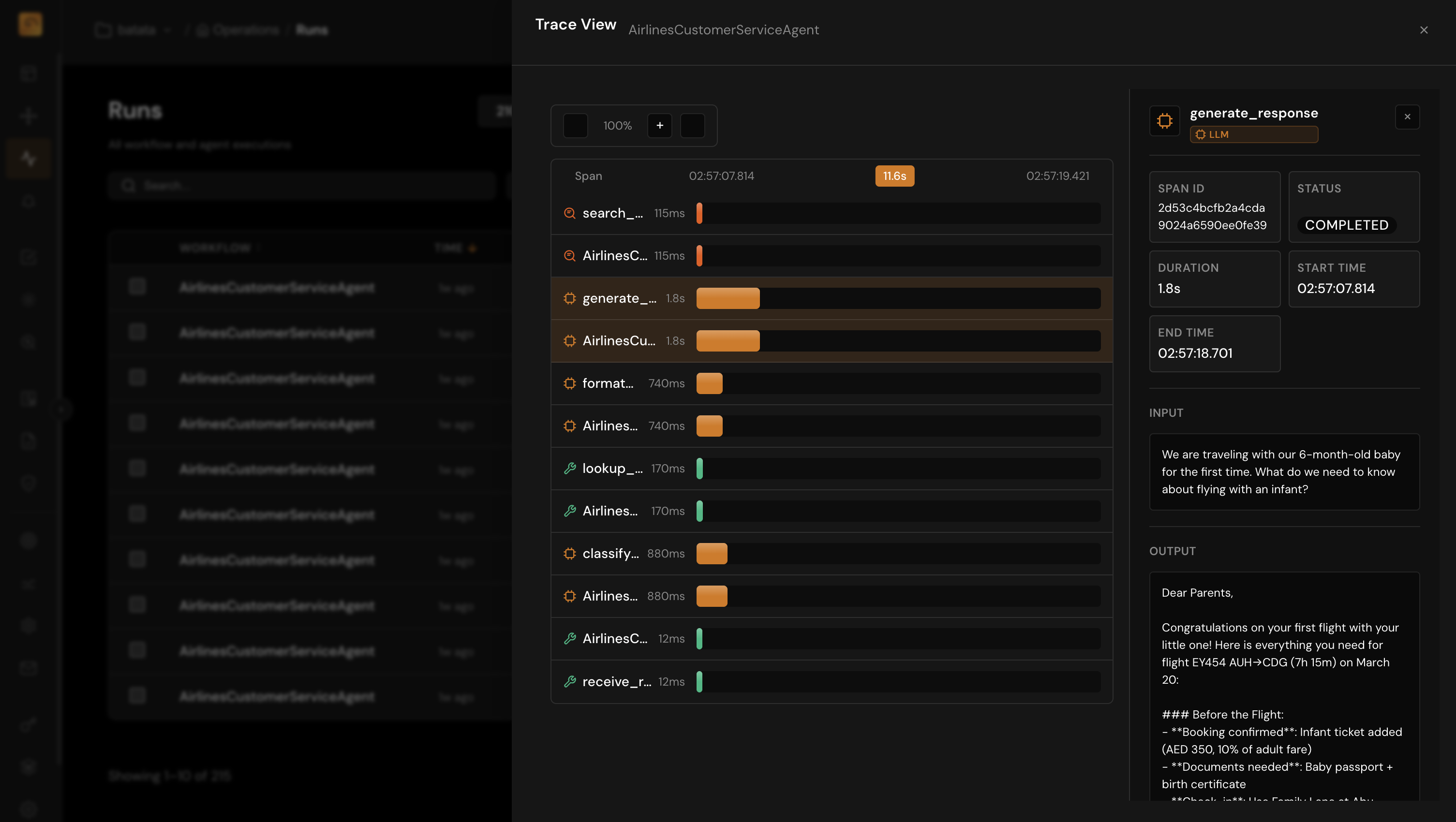
- Did the agent take an inefficient tool-calling path? — An agent might call the same tool three times before getting the right parameters. The trace completes successfully, but the cost and latency are tripled.
- Is output quality degrading over time? — Gradual quality drift across thousands of executions is invisible to point-in-time monitoring. It requires statistical comparison against historical baselines.
These questions require monitoring infrastructure that understands agent-specific concepts: traces with nested spans, LLM call parameters, token counts, tool invocation sequences, and quality evaluation scores.
What to monitor in AI agent systems
Effective AI agent monitoring covers five categories of signals. Each captures a different dimension of agent health, and together they provide comprehensive visibility into how agents are performing in production.
Latency
End-to-end workflow execution time, per-LLM-call latency, and individual tool call durations. Latency monitoring reveals slowdowns caused by model provider degradation, inefficient agent strategies that make excessive API calls, or retriever queries that return too many documents. Track p50, p95, and p99 percentiles across workflows to establish baselines and detect regressions.
Cost and token usage
Input tokens, output tokens, and total tokens per LLM call. Cost per trace, cost per workflow, and aggregate cost trends over time. Token monitoring is essential for preventing budget overruns — a single prompt regression can multiply costs across every execution. Understanding token economics helps teams set appropriate thresholds and track cost efficiency as models and prompts evolve.
Error rates
LLM API failures, tool call errors, timeout rates, and retry counts. Critically, error monitoring for AI agents must distinguish between infrastructure errors (provider outages, rate limits, network timeouts) and agent logic errors (malformed tool call arguments, infinite loops, context window overflows). Each category requires different alerting thresholds and different response playbooks.
Quality metrics
Custom KPIs like accuracy, relevance, faithfulness, and coherence scores. These can be computed via automated evaluations (LLM-as-judge, heuristic checks, ML classifiers) or through human review workflows. Quality metrics are the most important category for AI agents because they capture the dimension that matters most to end users — whether the agent is actually producing useful, correct output.
Behavioral patterns
Tool selection frequency, reasoning chain depth, retry patterns, and execution path distributions. Behavioral monitoring detects when agent behavior changes even without explicit errors. If an agent that normally calls a search tool once per trace suddenly starts calling it four times, something has changed — even if every individual call succeeds. Tracking these patterns over time provides early warning signals before performance or cost metrics are visibly affected.
Drift detection: catching silent regressions
AI agents can degrade without triggering a single error. A model provider updates their weights, a prompt template is modified, a retriever index is rebuilt with different data, or user input patterns shift. Any of these can cause subtle quality drops that accumulate over days or weeks before anyone notices. By then, thousands of users may have received subpar responses.
Drift detection solves this by continuously comparing current metric values against historical baselines using statistical methods. Rather than requiring teams to manually define every possible failure mode, drift detection automatically surfaces when any monitored metric deviates significantly from its established pattern.
TuringPulse supports multiple detection algorithms, each suited to different metric characteristics:
- Z-score analysis — Measures how many standard deviations a current value is from the historical mean. Effective for normally distributed metrics like latency and cost per trace.
- Percentage change thresholds — Alerts when a metric changes by more than a configured percentage compared to the baseline period. Simple and interpretable for metrics like error rate or token count.
- IQR-based outlier detection — Uses interquartile range to identify outliers in skewed distributions. Robust against extreme values that would distort mean-based methods.
Drift monitoring covers both performance drift (latency increases, error rate spikes) and behavioral drift (token usage pattern changes, cost trend shifts, quality score degradation). Rules can be scoped to specific workflows, agents, or node types, and configured with different sensitivity levels depending on the metric's criticality.
Anomaly rules and KPI thresholds
Drift detection identifies changes relative to historical patterns. But teams also need two complementary mechanisms: absolute limits they define explicitly, and statistical detection that adapts to evolving baselines.
KPI thresholds
Static limits that define acceptable operating ranges for specific metrics. Examples include: "alert if p95 latency exceeds 5 seconds," "alert if cost per trace exceeds $0.50," or "alert if error rate exceeds 2% over a 15-minute window." KPI thresholds are simple, predictable, and easy for teams to reason about. They are ideal for well-understood metrics where you know exactly what "too high" or "too low" means.
Thresholds can be configured per workflow, per agent, or at the project level, with inheritance — more specific scopes override less specific ones. This lets teams set conservative defaults and relax them for workloads with known higher baselines.
Anomaly rules
Statistical detection that adapts to the natural patterns of each metric. Rather than a fixed number, anomaly rules define conditions like "alert if the error rate is 3 standard deviations above the rolling 7-day average" or "alert if token usage exceeds the 95th percentile of the last 30 days." This catches issues you did not anticipate when writing threshold rules — the unknown unknowns of production AI systems.
Advanced anomaly rules support composite conditions that combine multiple metrics. For example: "alert if latency increases by more than 50% AND error rate exceeds 1% simultaneously." Composite rules reduce false positives by requiring multiple signals to confirm an issue before triggering an alert.
Alert routing and incident management
Detection without notification is just logging. When monitoring identifies a drift event, anomaly, or threshold breach, the right people need to know immediately — through the channel they are already watching. TuringPulse supports alert delivery via Slack, PagerDuty, email, Microsoft Teams, and custom webhooks, with per-channel configuration for each alert rule.
Severity-based filtering ensures that critical alerts (production outages, cost spikes above budget) reach on-call engineers through PagerDuty or high-priority Slack channels, while informational alerts (minor drift events, low-impact anomalies) are routed to dashboards or low-priority channels. This separation prevents alert fatigue — the single biggest risk to any monitoring system's long-term effectiveness.
Rate limiting and deduplication prevent notification storms during cascading failures. If a model provider outage triggers hundreds of individual error alerts, the system consolidates them into a single incident notification with aggregated context. Teams see one actionable alert instead of a wall of noise.
Proactive vs. reactive monitoring
Reactive monitoring means waiting for users to report that something is wrong — a support ticket about incorrect answers, a complaint about slow responses, or a finance alert about unexpected cloud bills. By the time you react, the damage is done. Users have lost trust, costs have accumulated, and root cause analysis requires sifting through hours or days of historical data.
Proactive monitoring detects and alerts before users are affected. AI agent monitoring should be proactive by design:
- Drift detection spots behavioral changes within hours of a model update or prompt change, before the quality degradation accumulates enough for users to notice.
- Anomaly rules catch statistical outliers in real time, flagging unusual patterns as they emerge rather than after they become systemic.
- KPI thresholds enforce quality floors continuously, ensuring that no single workflow execution falls below acceptable standards without triggering a notification.
The combination of all three — drift detection for trends, anomaly rules for outliers, KPI thresholds for absolute limits — creates a monitoring system that catches issues at different time scales and different severity levels. Together, they form a comprehensive early warning system for AI agent operations within a broader AI agent control plane.
AI agent monitoring vs. LLM observability
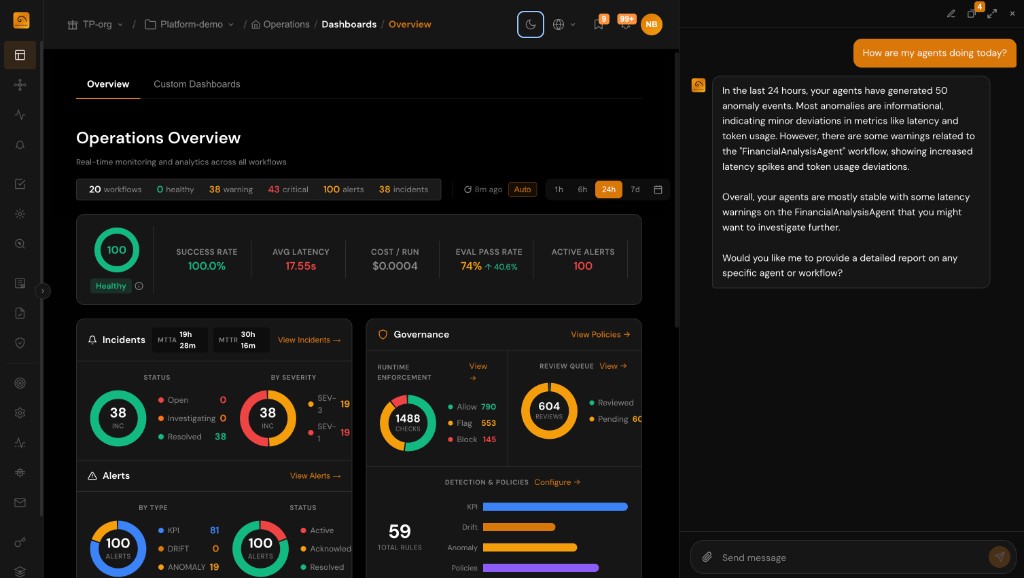
LLM observability focuses on collecting and visualizing telemetry — traces, spans, cost data. It answers "what happened?" An AI agent monitoring platform extends observability with detection, alerting, and operational response capabilities. It answers "what happened, is it normal, and who needs to know?"
Observability provides the data foundation. Monitoring adds the intelligence layer — statistical analysis, threshold enforcement, alert routing, and incident workflows — that turns raw telemetry into operational awareness.
Start monitoring your AI agents
Track latency, cost, quality, and behavioral drift across all your AI agent workflows. Start free with 1,000 traces/month.