AI Agent Governance: Enforcing Trust in Autonomous Systems
AI agent governance is the practice of defining, enforcing, and auditing the rules that autonomous AI systems must follow. Unlike traditional software governance — where code reviews, access controls, and deployment gates are sufficient — AI governance must account for non-deterministic behavior, model drift, prompt injection risks, and the delegation of consequential decisions to LLMs.
Why AI agents need governance
AI agents make autonomous decisions that can have real-world consequences — approving loan applications, triaging support tickets, generating legal documents, or orchestrating multi-step workflows across enterprise systems. The more authority you delegate to an agent, the higher the operational and regulatory risk.
Without governance, teams face a compounding set of problems:
- No audit trail for regulatory compliance — Regulators in healthcare, finance, and legal increasingly require evidence of how AI-driven decisions were made. Without structured logging, you cannot demonstrate compliance.
- No mechanism to block high-risk actions — An agent that autonomously sends emails, modifies records, or invokes external APIs needs guardrails that prevent it from exceeding its intended authority.
- No cost or quality controls — Without enforcement at runtime, token costs can spiral and output quality can degrade silently after model updates or prompt changes.
- No human oversight for sensitive decisions — Fully autonomous execution is appropriate for low-risk tasks, but high-stakes decisions require a mechanism to pause, review, and approve before the agent proceeds.
These problems compound in multi-agent systems where agents delegate to sub-agents, creating chains of autonomous decisions that are difficult to trace without a purpose-built governance layer. A well-designed control plane addresses this by integrating governance into the operational infrastructure.
What AI agent governance covers
Governance for AI agents spans four interconnected areas. Each maps directly to operational capabilities that teams need to maintain trust in production systems.
Policy enforcement
Policy enforcement means defining declarative rules that are evaluated at runtime — as agent actions happen, not after the fact. Examples include blocking actions that exceed a cost threshold, requiring human approval before an agent sends external communications, enforcing latency budgets for user-facing workflows, and restricting which tools an agent can invoke based on its role.
TuringPulse supports 30+ condition types with tenant-level overrides, enabling teams to express complex governance logic as configuration rather than custom code. This is the foundation of what we call governance as code — versioned, reviewable, and enforceable.
Compliance frameworks
Compliance packs translate regulatory requirements into engineering controls. Rather than asking teams to interpret HIPAA, GDPR, or the EU AI Act themselves, pre-built packs map specific regulatory clauses to policy rules, audit requirements, and reporting templates.
Each compliance pack includes enforcement logging that captures every policy evaluation result, creating the evidentiary trail that auditors and regulators require.
Human oversight patterns
Not every agent decision should be fully autonomous. Human oversight comes in three coordination models, each suited to a different risk profile: HITL (human-in-the-loop), where the agent pauses and waits for approval before proceeding; HATL (human-after-the-loop), where the agent executes and a human reviews afterward; and HOTL (human-on-the-loop), where the agent executes with real-time human monitoring and intervention capability.
Choosing the right model depends on the stakes, the latency tolerance, and the volume of decisions. Most production systems use a combination — automated for routine work, HITL for high-stakes decisions.
Audit trails
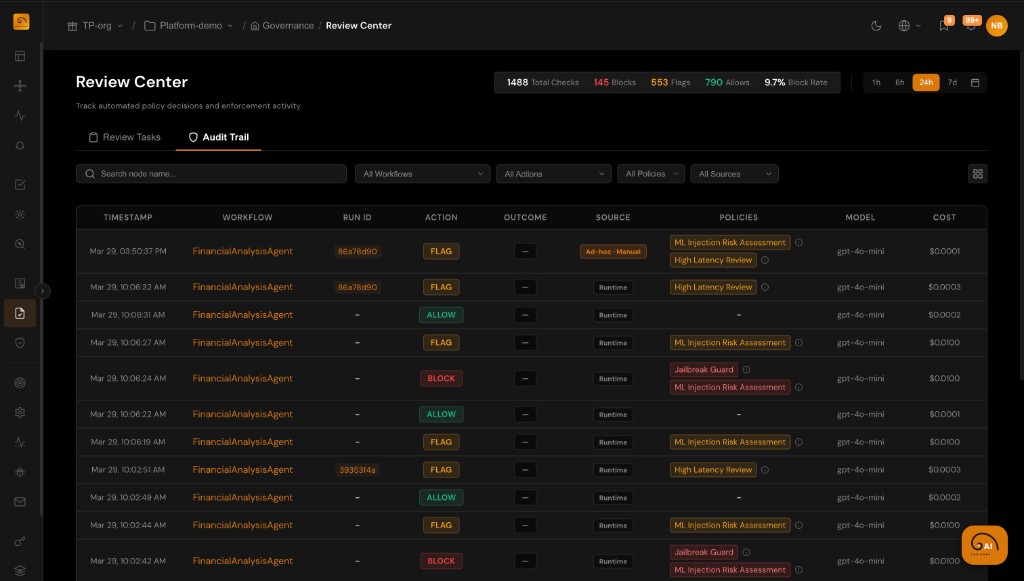
Every policy evaluation, human review decision, and enforcement action is recorded with a timestamp, the decision context, and the outcome. This creates a structured accountability record that serves two purposes: regulatory compliance (demonstrating to auditors that governance controls are in place and functioning) and internal accountability (enabling teams to review enforcement patterns, identify gaps, and improve policies over time).
Audit trails are most valuable when they are queryable and connected to traces — so you can navigate from a governance event to the full execution context of the agent decision that triggered it.
Governance vs. guardrails
The terms "governance" and "guardrails" are often used interchangeably, but they address different layers of the problem. Guardrails are input/output filters applied to individual LLM calls — prompt injection detection, content filtering, PII redaction, toxicity checks. They operate at the model interaction level and are typically stateless.
Governance is broader. It operates at the workflow level, considers business context (cost, compliance, organizational policy), involves human coordination, and produces audit trails. Governance rules can span multiple agent steps — for example, "if total cost for this workflow exceeds $5, pause and request human approval before continuing."
A complete system needs both. Guardrails protect individual LLM calls from adversarial inputs and harmful outputs. Governance ensures the overall agent operation aligns with organizational policies, regulatory requirements, and risk tolerances. TuringPulse integrates both layers within the control plane, so enforcement is consistent from the model call up to the workflow level.
The four governance patterns
Every governance decision falls into one of four patterns based on the level of human involvement. Choosing the right pattern for each decision type is a core governance design task.
HITL — Human-in-the-Loop
The agent pauses execution and waits for explicit human approval before proceeding. The reviewer sees the full context — inputs, proposed action, risk factors, and the trace leading to this point — and can approve, reject, or modify the action.
Use for high-stakes decisions where errors are costly or irreversible: financial transactions above a threshold, medical recommendations, legal document generation, or any action that modifies external systems with real-world consequences.
HATL — Human-after-the-Loop
The agent executes the action, then the decision is queued for human review afterward. If the reviewer identifies a problem, they can flag the decision, trigger a rollback, or update the governance policy to prevent recurrence.
Use for medium-risk actions where speed matters but accountability is required: content moderation decisions, automated customer responses, internal report generation. The review happens asynchronously and can be sampled rather than exhaustive.
HOTL — Human-on-the-Loop
The agent executes in real time with continuous human monitoring. A human operator observes agent behavior through live dashboards and can intervene at any point — pausing execution, overriding a decision, or escalating to a more senior reviewer.
Use for production systems where you want oversight without blocking throughput: live customer-facing agents, real-time data processing pipelines, or any system where the cost of delay exceeds the cost of occasional correction.
Automated — Policy-Driven Enforcement
Policies are evaluated and enforced without any human involvement. The governance engine evaluates conditions in real time and takes action — blocking, allowing, or routing — based on declarative rules. Every evaluation is still logged to the audit trail.
Use for low-risk, high-volume decisions where the rules are clear-cut: enforcing token budgets, rate limiting agent invocations, blocking known-bad patterns, or applying content filters. Automated governance is the default for the majority of agent actions in a mature system.
How to implement AI agent governance
Governance is most effective when introduced incrementally. Starting with full policy enforcement on day one is impractical — you need visibility into what your agents are doing before you can write meaningful rules. Here is the sequence that works in practice:
- Start with audit trails — Instrument your agents with the TuringPulse SDK to capture traces, spans, and metadata for every execution. This gives you the visibility foundation that all governance rules will build on.
- Define policies — Use the policy engine to create governance rules based on what you observe in the traces. Start with broad rules (cost limits, error rate thresholds) and refine as you learn your agents' behavior patterns.
- Configure human oversight — Set up review queues for high-risk decisions. Define which agent actions require HITL approval, which get post-execution review, and which are fully automated.
- Apply compliance packs — Map your regulatory requirements to the appropriate compliance pack. The pack activates the relevant policy rules, audit requirements, and reporting templates for your industry.
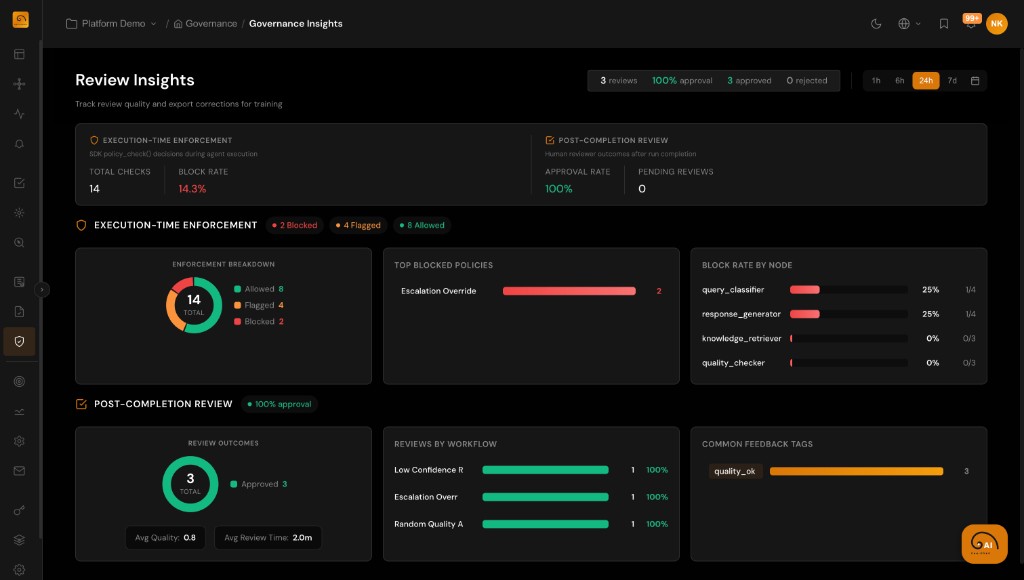
- Monitor and iterate — Use governance insights dashboards to track approval rates, enforcement patterns, and policy effectiveness. Adjust rules as your agents evolve and as you identify gaps.
Governance in regulated industries
The governance requirements for AI agents are most acute in industries where decisions have direct consequences for people. Regulatory bodies are increasingly publishing guidance on AI oversight, and organizations that deploy agents without governance infrastructure face both compliance risk and reputational risk.
- Healthcare — HIPAA requires audit trails for AI-assisted clinical decisions. Agents that process patient data, generate clinical summaries, or support diagnostic workflows must demonstrate that governance controls are in place and functioning. The HITL pattern is typically required for any recommendation that influences treatment.
- Finance — Model risk management (SR 11-7) and fair lending regulations require that AI-driven decisions are explainable, auditable, and free from prohibited bias. Governance policies enforce approval workflows for credit decisions, flag anomalous patterns in automated trading, and maintain the decision logs that examiners review.
- Legal — AI agents used for document review, contract analysis, and legal research must operate under governance policies that ensure accuracy, track provenance, and maintain attorney-client privilege boundaries. Post-execution review (HATL) is common for AI-generated legal work product.
TuringPulse's compliance packs provide the starting point for each of these industries, mapping regulatory requirements to specific policy rules, audit configurations, and reporting templates that teams can customize for their use cases.
Build governance into your AI agents
Define policies, enforce compliance, coordinate human oversight, and maintain audit trails — all from a single platform. Start free with 1,000 traces/month.