Compliance

AI Compliance: Meeting Regulatory Requirements for Autonomous Agents

AI compliance means ensuring that autonomous AI systems operate within legal and regulatory boundaries. As AI agents move from prototypes to production, organizations face increasing regulatory scrutiny from frameworks like the EU AI Act, HIPAA, and GDPR. Compliance is not about checking boxes — it requires engineering controls that produce verifiable evidence of responsible AI operation across every agent interaction.

The regulatory landscape for AI agents

Multiple regulatory frameworks now apply to organizations deploying AI agents. Each imposes different requirements, but they share common themes: transparency, accountability, human oversight, and data protection. Understanding the landscape is the first step toward building compliant AI systems.

EU AI Act

The EU AI Act introduces a risk-based classification system with four tiers: unacceptable, high, limited, and minimal risk. High-risk AI systems — which include AI agents that make autonomous decisions in healthcare, finance, or legal contexts — require conformity assessments, technical documentation, human oversight mechanisms, and post-market monitoring. Organizations must demonstrate that their AI systems meet these requirements before deployment and maintain compliance throughout the system lifecycle.

For a deeper look at how the EU AI Act applies to agent-based systems, see our analysis on AI regulation and compliance in 2026.

NIST AI Risk Management Framework

The NIST AI RMF is a voluntary framework structured around four functions: Govern, Map, Measure, and Manage. It provides practical guidance for identifying, assessing, and mitigating AI risks. While not legally binding, it serves as a reference standard for organizations building internal AI governance programs and is increasingly cited by regulators as a compliance benchmark.

HIPAA

AI agents handling protected health information (PHI) must comply with HIPAA requirements for data security, access controls, and audit trails. Every interaction involving patient data must be logged with sufficient detail to reconstruct what data was accessed, by which agent, for what purpose, and what decision was made. Data minimization principles apply — agents should only access the minimum data necessary for their task.

GDPR

AI agents processing data of EU citizens must support the right to explanation (Article 22), data portability, and consent management. Automated decision-making that significantly affects individuals requires meaningful information about the logic involved. Agents must also respect data subject access requests and deletion rights, which means maintaining clear records of what data each agent processes and providing mechanisms to purge it on request.

Why compliance is hard for AI agents

Traditional software compliance relies on deterministic behavior, static code analysis, and well-defined input-output contracts. AI agents break these assumptions in fundamental ways:

  • Non-deterministic outputs — The same input can produce different results across executions. This makes traditional regression testing insufficient and requires statistical approaches to quality validation.
  • Opaque reasoning — LLM decision-making is not inherently explainable. Regulators requiring "meaningful information about the logic involved" cannot be satisfied by pointing to a neural network's weights.
  • Dynamic behavior — Model updates, prompt changes, and retrieval context shifts can alter agent behavior without any code changes, making change management and version control more complex.
  • Multi-step autonomy — Agents chain decisions across multiple steps, each with its own inputs, outputs, and potential compliance implications. A single trace may involve dozens of LLM calls, tool invocations, and data accesses that all need auditing.
  • Vendor dependencies — Reliance on third-party LLM providers introduces supply chain compliance risks. Model providers may update their models without notice, changing your agent's behavior and potentially its compliance posture.

These challenges mean that compliance for AI agents cannot be achieved through manual audits alone. It requires automated, continuous engineering controls embedded into the agent operations layer.

Building compliance into AI agent operations

Effective AI compliance is not a bolt-on — it must be engineered into the operational infrastructure that manages your agents. The following controls form the foundation of a compliance-ready AI agent platform.

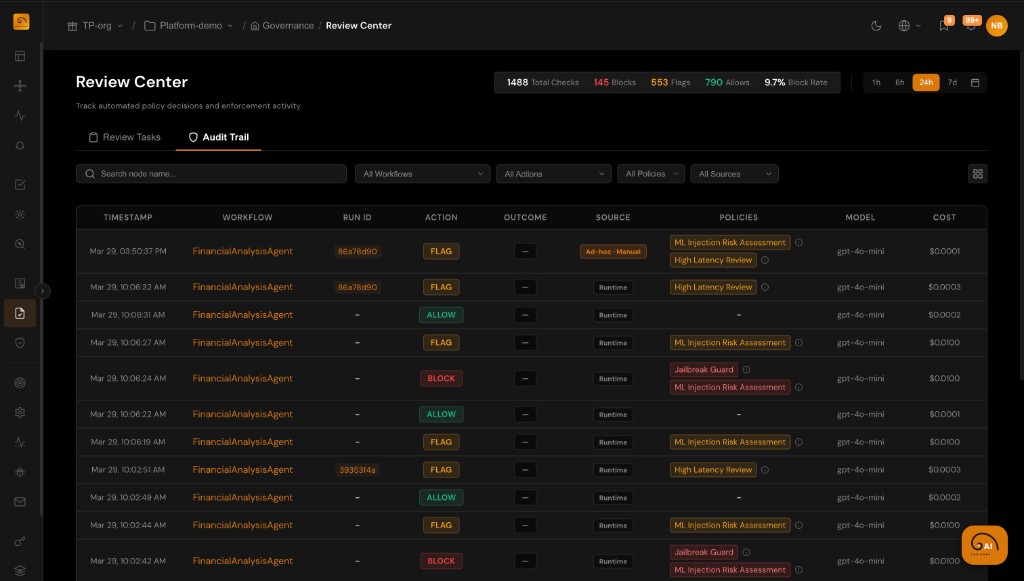
Audit trails

Every agent action — LLM calls, tool invocations, retriever queries, and final decisions — must be logged with timestamps, inputs, outputs, and execution context. These logs must be immutable, tamper-evident, and queryable. TuringPulse captures this telemetry automatically through SDK instrumentation, creating a complete provenance chain for every trace without requiring changes to your application code.

For a detailed look at how audit trails can be implemented as code, see accountability as code.

Policy enforcement

Declarative rules evaluated at runtime form the backbone of compliance enforcement. Policies can block, flag, or route agent actions based on compliance requirements — for example, "require human review for any clinical recommendation" or "block requests that exceed data retention limits." TuringPulse's policy engine supports 30+ condition types with tenant-level overrides, ensuring that different business units can maintain different compliance postures within the same platform.

Learn more about defining AI agent governance policies and how governance as code makes compliance auditable and version-controlled.

Compliance packs

Pre-built policy sets mapped to specific regulatory frameworks reduce the time from deployment to compliance. Each pack includes policy definitions, condition templates, and references to the specific regulatory requirements they address. Apply a HIPAA compliance pack to your tenant and the relevant policies — PHI redaction, access logging, retention enforcement — are automatically activated. Packs can be customized and extended to match your organization's specific interpretation of regulatory requirements.

Data governance

Compliance requires control over the data that flows through your agents. Field-level redaction strips sensitive data (PII, PHI) from traces before storage. Configurable data retention periods ensure that data is not held longer than regulations permit. Tenant-scoped isolation guarantees that no cross-tenant data leakage can occur, with every query enforcing tenant boundaries at the database level.

Compliance by industry

Different industries face different regulatory requirements. Each demands specific compliance controls tailored to its regulatory environment and risk profile.

Healthcare

Healthcare AI agents operate under HIPAA and, in many jurisdictions, additional clinical decision support regulations. Compliance requires complete audit trails for every patient data access, automated PHI redaction in trace storage, and documentation of clinical decision support outputs. Adverse event logging must capture the full agent reasoning chain when outcomes deviate from expectations, enabling post-incident review by clinical oversight committees.

TuringPulse's HIPAA compliance pack activates field-level PHI redaction, enforces access control policies, and generates audit-ready reports documenting every agent interaction with patient data.

Financial services

Financial AI agents must comply with model risk management standards (SR 11-7), fair lending requirements, and transaction monitoring regulations. Every model-driven decision requires documentation of the model used, inputs considered, and rationale produced. Explainability is not optional — regulators expect institutions to articulate why an AI system made a specific recommendation, especially for credit, insurance, and investment decisions.

Audit trails that capture complete decision provenance, combined with drift detection that flags unexpected behavioral changes, form the foundation of financial AI compliance.

Legal

Legal AI agents performing document review, contract analysis, or case research must maintain provenance for every output. Privilege classification decisions require full audit trails — if an agent flags a document as privileged or non-privileged, the reasoning chain and source data must be reproducible. Client data isolation is paramount: multi-tenant legal AI platforms must guarantee that no data from one client matter is accessible to agents operating on behalf of another.

Tenant-scoped isolation and immutable audit logs ensure that legal AI operations meet professional responsibility and data protection standards.

Enterprise AI

Large organizations deploying AI agents across business units need internal governance standards that go beyond external regulation. This includes cost controls that prevent runaway spending on LLM API calls, access management that restricts which teams can deploy which agents, and third-party model risk assessments that evaluate the compliance implications of vendor model changes.

A centralized AI agent control plane provides the unified visibility and policy enforcement that enterprise governance programs require.

Provenance and reproducibility

For compliance purposes, it is not enough to know what an agent did — you must be able to reconstruct why it did it. Provenance engineering captures the complete decision context: model version, prompt template, system configuration, input data, retrieval context, and environmental state at the time of execution.

When a regulator or internal auditor asks "why did your AI agent make this decision?", the answer must be specific and evidence-backed. TuringPulse's fingerprinting feature detects when any component of the decision context changes — model version, prompt text, configuration parameters — enabling teams to correlate behavioral shifts with specific configuration changes and produce the documentation that compliance requires.

Read more about how provenance and reproducibility form the technical foundation of AI compliance.

Continuous compliance monitoring

Compliance is not a one-time audit — it requires continuous monitoring to detect and respond to compliance risks as they emerge. Point-in-time assessments miss the dynamic nature of AI agent behavior, where a model update or prompt change can shift compliance posture overnight.

Drift detection alerts teams when agent behavior deviates from established baselines, which may indicate a compliance risk. If a clinical AI agent suddenly starts producing longer responses with different terminology, that behavioral shift could signal a model update that requires re-validation against clinical standards. KPI thresholds enforce quality floors — if success rates drop below defined minimums or error rates spike, alerts fire before degraded behavior affects compliance.

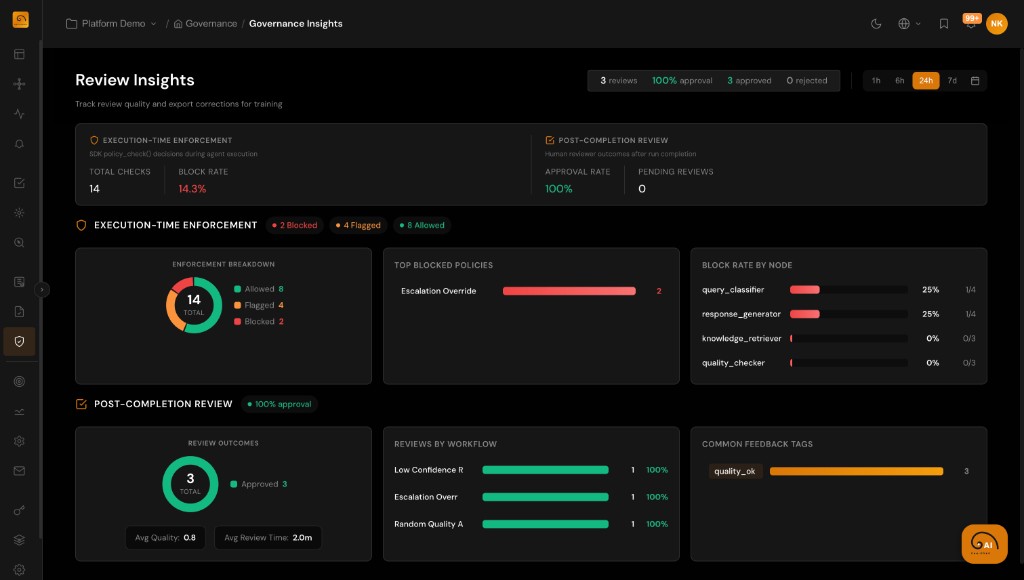
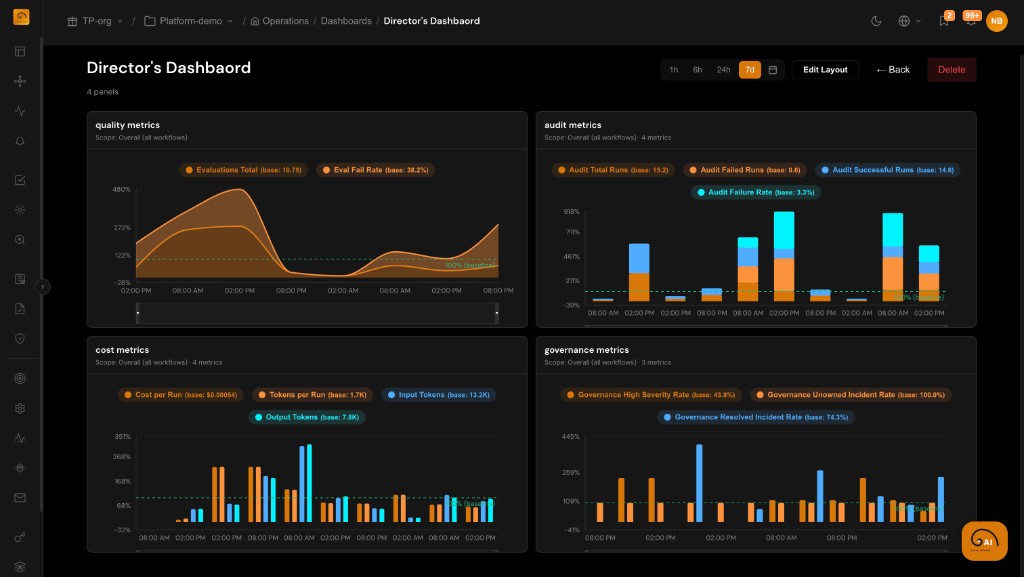
Governance insights dashboards provide real-time visibility into policy enforcement rates, human review queue throughput, and overall compliance posture across your agent fleet. These dashboards serve as the operational interface for compliance officers and engineering leads who need to demonstrate ongoing regulatory adherence.

Build compliance into your AI agents

Audit trails, policy enforcement, compliance packs, and continuous monitoring — all built in. Start free with 1,000 traces/month.

Get Started FreeRead the Docs